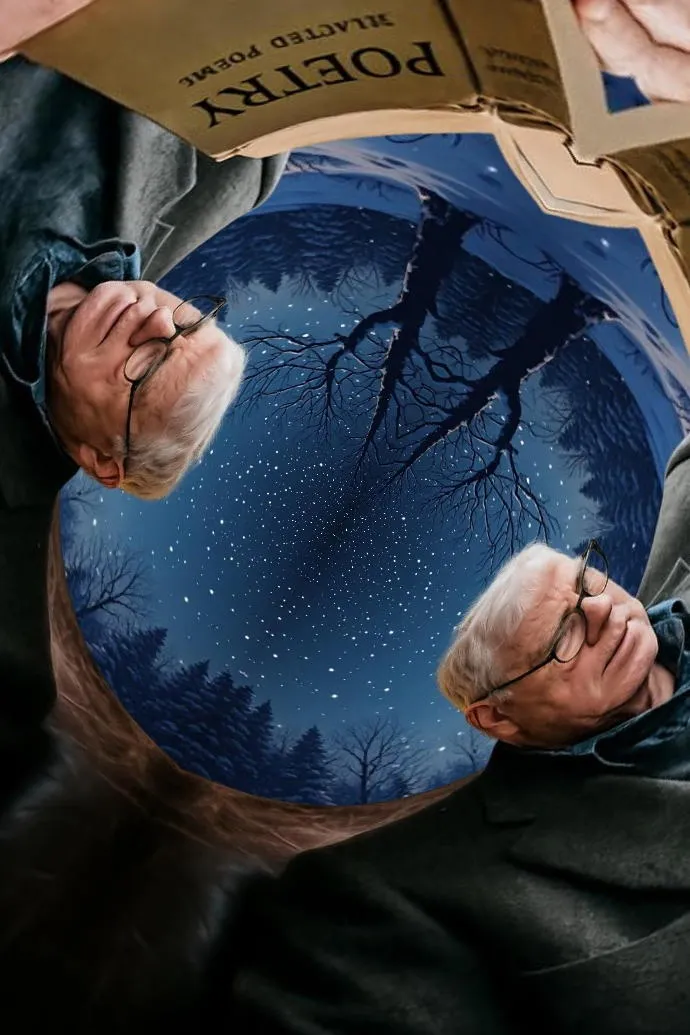
FOR ROBERT FROST: A Classroom Deconstruction - artwork by T Newfields

With poems with the symmetry of powdered snowflakes
and warmth of Vermont landscapes
written with the restraint of Wyeth scenes
your nostalgic etchings
are best seen from far away,
when the edges soften
and the mind can’t quite correct the glow.

In fourth grade, my teacher loved your voice, making us memorize
"Whose woods these are…"
While we stared into blank space…
your lines sat in our mouths like old coins or heavy keys.

In ninth grade, your works appeared next to Dickenson
and as Miss Schwartzbaum recited, I tried to imagine how she felt,
but began to wonder, "who gives a damn about New England
or fenced-in calm?

In college the social isolation of your works came into question
as the instructor encouraged us to ask:

What politics do poems smuggle?
What flags do metaphors serve?
Was Vietnam part of America’s woods?
How would Cubans read the claim of resting?

Now and then your words come to life—
embroidered, emblazoned, along with
Scarlet Letters, Ravens, Ahab’s ache,
and there you are again.

However, by this time I grew tired.
Perhaps winter came too late?
I have acute frostbite,
and poetry melts like snow.

Overkill
Under teach
Dissecting literature like tissue under glass—
till even line sounds distant,
and all woods go quiet
and questions go on unheard.

Jack slumped back in his chair, staring down at the open textbook with a slight frown. "This poem was a bit too frosty for me," he muttered, rubbing his arms as if a cold draft had just swept through the seminar room.

Juanita offered a sharp, knowing nod, tapping her pen against the edge of the table. "Well, it shows how not to teach literature," she said, leaning forward. "One can easily memorize dates and authors and poems without learning much about literature."

"Yeah," Jean agreed, looking thoughtfully out the window before turning back to the group. "Until we learned to see ourselves in each drama or poem, perhaps we haven't learned."

A quiet settled over the table, punctuated only by the distant hum of the campus. Juanita rested her chin in her hand, her eyes bright with a sudden, radical thought. "At times I'm even tempted to say there is no such thing as 'literature'—just an ongoing dialog between readers and writers."

Ella, who had been quietly absorbing the debate, finally spoke up, a skeptical smile playing on her lips. "Perhaps," she countered, gesturing vaguely toward the hallway outside, "but then what are people doing in school? You see, we grow up with this cultural artifact called 'literature.' And really, it's like an elephant that represents different things to different people."